Gabriel Franchère, the Fort Astoria clerk whose diary became Astoria’s first history
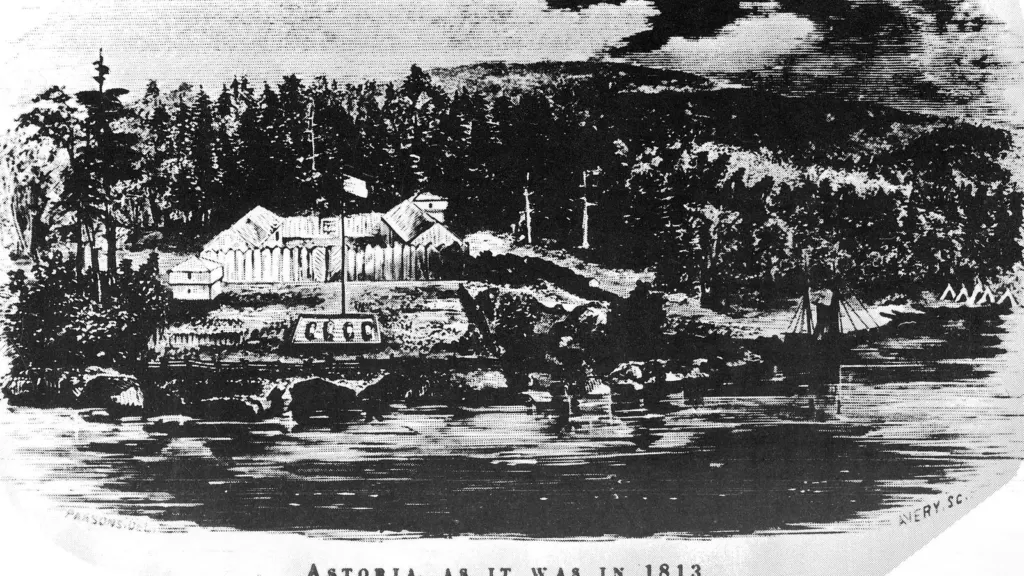
An 1854 engraving titled "Astoria, as it was in 1813." Photo: Gabriel Franchère via Avery, U.S. Forest Service- Pacific Northwest Region / Wikimedia Commons, public domain
Most of what people know about Astoria’s first years comes, one way or another, from a young Montreal clerk named Gabriel Franchère. He spent his whole time in the Pacific Fur Company’s service at the post at the mouth of the Columbia River, and the diary he kept there became what the Dictionary of Canadian Biography calls the best single account of the Astor enterprise.
Franchère was born in Montreal on Nov. 3, 1786, the son of a merchant who later became master of the port there. Almost nothing is known of his early life. That changes in the spring of 1810, when he signed on as a clerk with John Jacob Astor’s new venture on the Columbia. He was one of a group of clerks and voyageurs recruited in Montreal, and he sailed from New York.
A clerk on the Tonquin
Franchère traveled with Duncan McDougall’s party on the hard voyage around Cape Horn aboard the Tonquin, under Captain Jonathan Thorn. The biography describes Thorn’s leadership on that trip as “disturbing.” The company set up its post, Fort Astoria, in 1811.
The post was meant to be the fortified headquarters of Astor’s plan to dominate the fur trade in western North America. It did not last long in American hands. The War of 1812 raised the threat of British attack, and the North West Company was competing hard. In October 1813 the Pacific Fur Company’s assets were sold to the Nor’Westers.
Franchère was, in the biography’s words, “a mere clerk in Astor’s vast plan.” He showed ability and common sense in the daily work of running the outpost, and he watched the rivalry between the two companies from inside it. In 1814 he went home to Canada with some of the other survivors of the Astor venture, traveling with a party of Nor’Westers.
The book that outlived the fort
His real contribution was the record he kept. Franchère wrote his diary, he said, to describe for family and friends “what I had seen and learned.” He had a manuscript ready about five years after he got back. Michel Bibaud, a Montreal journalist, edited and expanded it, and it was published in French in 1820.
The book became a rare and valued item in Lower Canada. It was also the only chronicle written by someone whose entire service was spent at the fort. That made it a central source for Washington Irving’s Astoria. It played a minor role in the 1846 congressional debates over the Oregon boundary, when Sen. Thomas Hart Benton invited Franchère to Washington.
The Oregon dispute, along with competing Astoria accounts by Irving, Ross Cox and Alexander Ross, led to an English translation in 1854. The American writer Jedediah Vincent Huntington prepared it with Franchère’s help. That edition, Narrative of a Voyage to the Northwest Coast of America, is free to read online. At least four more versions have been published since, each with its own notes and introduction.
Life after Astoria
Back in Montreal, Franchère married Sophie Routhier on April 24, 1815. He stayed in the fur business. From 1828 to 1834 he was chief agent of Astor’s American Fur Company in Montreal, hiring the engagés who worked the trade from the company’s base at Mackinac. When Astor left the fur trade in 1834, Franchère agreed to run the company’s agency at Sault Ste. Marie, Mich.
In 1842 he became the New York agent of Pierre Chouteau Jr. and Company. That same year the American Fur Company failed, and a friend later wrote that Franchère gave up his own fortune to help pay its debts. He founded his own fur commission house in Brooklyn in 1857.
In New York he also built ties with French Canadians on both sides of the border. Around 1850 he was recognized as the founder of the first American branch of the Société Saint-Jean-Baptiste. On a visit to Montreal in 1853, 100 leading citizens signed an address honoring his work as president of the New York society.
He and Sophie had eight children, six of whom survived childhood. After her death in 1837, he married Charlotte Prince, a widow from Detroit, in 1839. Franchère died in St. Paul, Minn., on April 12, 1863.
Two centuries on, Astoria’s first chapter is still told largely in his words, alongside the earlier accounts of Robert Gray’s 1792 crossing and the Lewis and Clark winter nearby. More profiles of figures who shaped the coast are in our Notable People section.
Add North Coast Oregon as a preferred source on Google (opens in a new tab)