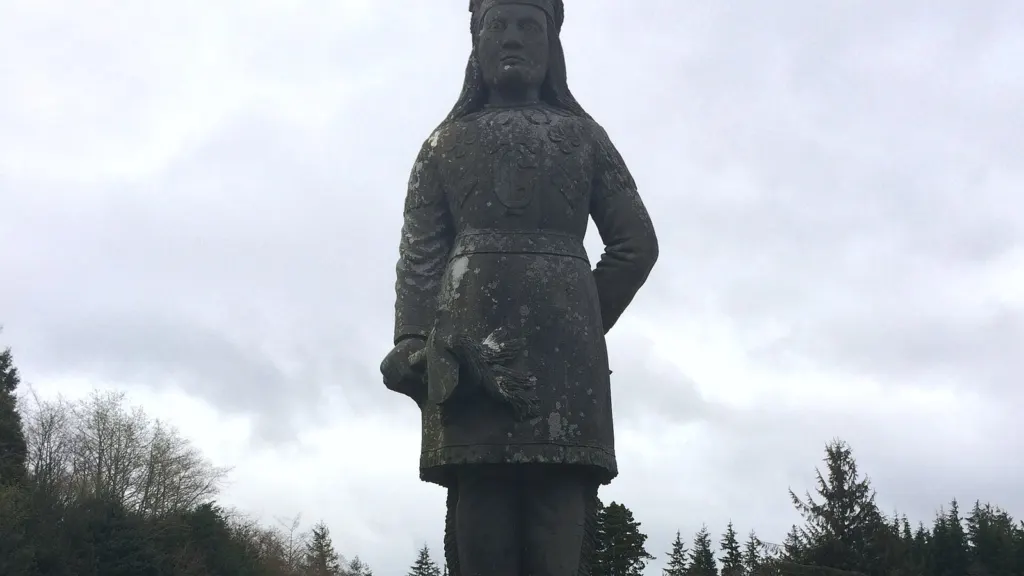
Comcomly, the Chinook leader at the mouth of the Columbia
Photo: Dsealy, CC BY-SA 4.0, via Wikimedia Commons.
Comcomly was a leader of the Chinook people living along the north shore of the lower Columbia River in the late 1700s and early 1800s. Chinook villages controlled much of the trade at the river’s mouth, and Comcomly became one of the most important figures dealing with the newcomers who arrived by sea and over land.
Lewis and Clark met him in 1805 and noted him in their journals. A few years later, when Astor’s Pacific Fur Company built Fort Astoria in 1811, Comcomly became a key trading partner. One of his daughters married Duncan McDougall, the fort’s chief factor, tying the post closely to the Chinook.
Trade and power
The Chinook played an essential role in the trade network, acting as go-betweens for coastal and interior peoples. Chinook Jargon, the trade language used across the Northwest, drew heavily on the Chinook language. Comcomly’s influence reflected that position.
The arrival of European and American traders also brought diseases that devastated the Chinook. Epidemics in the 1830s killed a large share of the people of the lower Columbia, and Comcomly died in 1830 during one of them.
Remembered
Comcomly’s skull was removed from his grave years after his death and taken to Britain, a practice common among collectors of the time. It was eventually returned and reburied in 1972. Today the Chinook Indian Nation, based in Bay Center, Washington, continues to seek federal recognition. A memorial to the Comcomly family and Chinook history stands in the area, and his name appears on a canoe memorial at the Astoria Column.
 By
 By