Terrible Tilly: the Tillamook Rock lighthouse that cost a life to build and ended as a columbarium
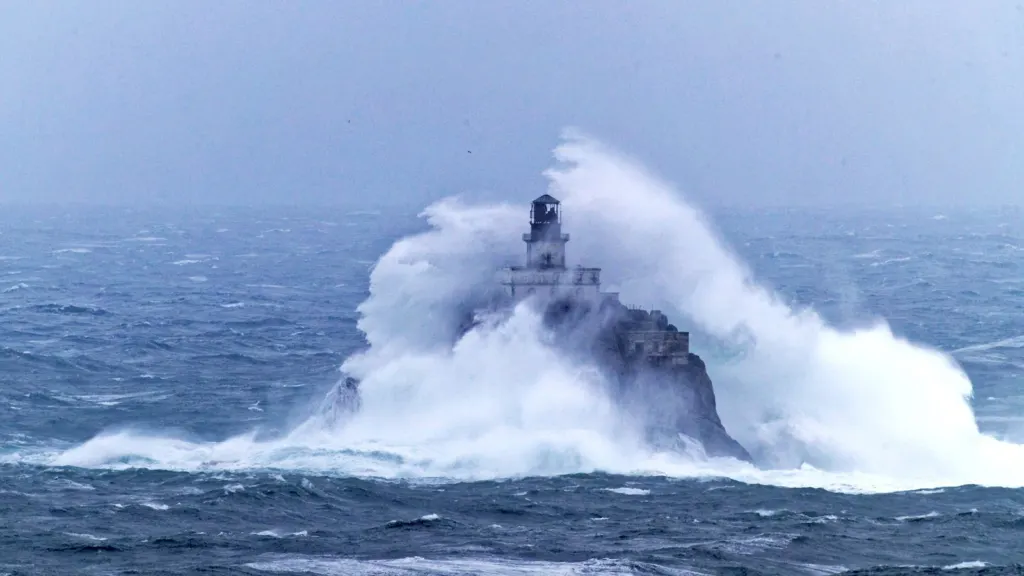
Waves break over Tillamook Rock Lighthouse off Tillamook Head in November 2018. Photo: Jwyoung / Wikimedia Commons, CC BY-SA 4.0
On a clear day from Ecola State Park, Tillamook Rock looks small: a dark knob of basalt with a square white building on top, about a mile off Tillamook Head. In a winter storm it is something else. Waves have broken over the 133-foot light, shattered its lens and sent boulders crashing into the building. The keepers who lived there called it Terrible Tilly.
The light has been dark since 1957, but the station remains one of the best-known landmarks on the north Oregon coast, and one of the strangest stories in its history.
A lighthouse nobody wanted to build
According to the Oregon Encyclopedia, Congress set aside $50,000 in 1878 for a first-class lighthouse to guide ships toward the Columbia River Bar. Officials first planned to put it on Tillamook Head itself, between Seaside and Cannon Beach, but decided the headland would not be visible enough to mariners heading for the bar. They chose the rock instead: an island of less than an acre, rising nearly 100 feet from the sea 1.2 miles west of the headland and about 20 miles south of the river’s mouth.
The work began with a death. John R. Trewavas, a 38-year-old master mason from Portland hired to survey the rock, lost his footing on its eastern face and was swept into the sea. Local craftsmen were reluctant to take the job after that, so the construction foreman, Charles A. Ballentyne, hired eight quarrymen from outside the area. They waited at Fort Canby, near Ilwaco, Washington, for a break in the weather and landed on Oct. 12, 1879.
The crew blasted the top of the rock flat with dynamite. One gale swept away their supply house and stranded them for 16 days. By the end of May 1880 the summit was level, and the cornerstone was laid on June 22. Ships stood off the rock while derricks hauled stone, sand, boilers for the fog signal and a first-order Fresnel lens up by cable.
The light went into service on Jan. 21, 1881. It cost nearly $125,000, more than twice the original appropriation, and the encyclopedia says it was the most expensive lighthouse built in the United States to that point.
Life on the rock
The U.S. Coast Guard’s historical record calls Tillamook Rock “one of the most exposed stations on the Pacific coast.” Although the lantern sits 133 feet above the water, its glass was shattered more than once by stones thrown up by waves. When a keeper and a workman fell seriously ill after a storm, a lighthouse tender could not get a boat to the rock, and the men had to be taken off by breeches buoy, a sling run along a line from ship to shore.
Supplies could be days or weeks late, and the only link to land was a telegraph cable to Indian Beach. In October 1934, a gale with winds over 100 mph sent waves over the tower, smashed the Fresnel lens, flooded the rooms and cut the cable. Keeper Henry Jenkins rigged a transmitter out of spare parts to reach the mainland.
The first head keeper, Albert Roeder, lasted four months. Others stayed for decades, including William Dahlgren, Robert Gerloff and George Wheeler. Oswald Allik, who started in the late 1930s, was head keeper when the Coast Guard closed the station on Sept. 1, 1957. By then radar and modern communications had made it obsolete, and it was the most expensive lighthouse in the country to maintain.
From lighthouse to columbarium
The government sold the rock, and it changed hands several times. In 1980 a real estate developer bought it, gutted the building, sealed the windows with cement and turned it into the Eternity at Sea Columbarium, where people paid $1,000 to $5,000 to have their ashes placed. The columbarium lost its license in 1999 over inaccurate recordkeeping, and later applications to renew it were rejected.
Tillamook Rock is still privately owned. It is part of the Oregon Islands National Wildlife Refuge, which protects the coast’s offshore rocks for wildlife, and the lighthouse is listed on the National Register of Historic Places. The sea lions and seabirds that lived on the rock before the builders arrived have returned.
The best view is from the trails and overlooks at Ecola State Park, on the headland that was once passed over for the lighthouse. For more north coast history, read about Lewis and Clark’s winter at Fort Clatsop, the Columbia River Bar Pilots who still guide ships across the bar the light was built to serve, and the artist behind the Astoria Column’s frieze.
Add North Coast Oregon as a preferred source on Google (opens in a new tab)
More in Community

tonies® Partners with Ronald McDonald House New York to Bring the Magic of Screen-Free Storytelling and Imaginative Play to Children and Families

Los Angeles Bariatric Surgeon Dr. Sepehr Lalezari Discusses the FDA’s New GLP-1 Vision Safety Warning on KNX News Radio

Cannon Beach offers owners up to $16,000 to rent homes to local workers for a year
 By Megan Harlow ·