Port of Longview signs Nutrien to a potash export terminal at Berth 4
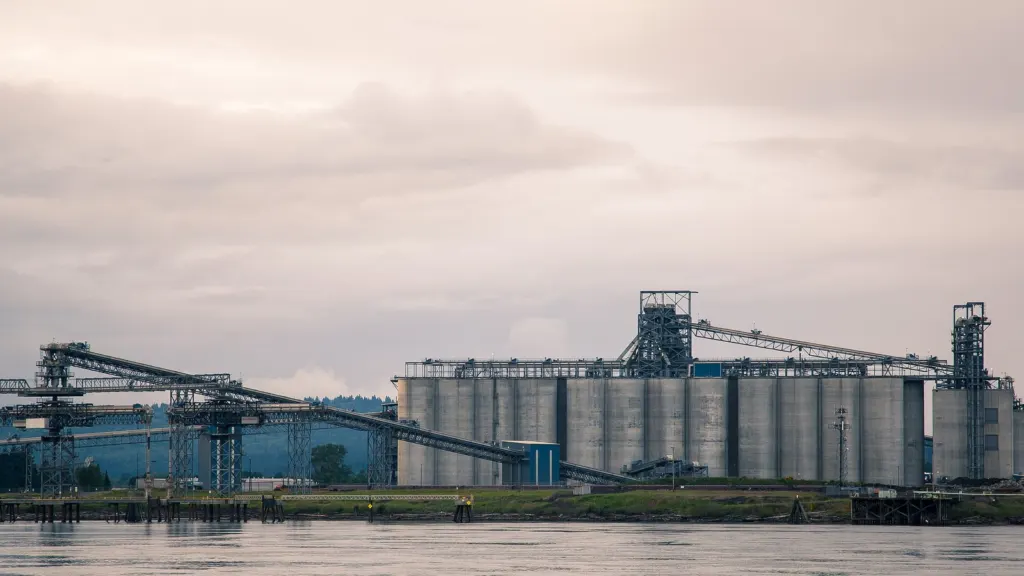
Port of Longview on the Columbia River. Photo: Tony Webster from Portland, Oregon / Wikimedia Commons, CC BY 2.0
The Port of Longview has signed Canadian fertilizer giant Nutrien to build a potash export terminal on Berth 4, the riverfront site that has sat largely idle since the old Continental Grain Terminal shut down in 1989.
Port commissioners voted unanimously at a special meeting on Monday, Nov. 16, to approve a site development agreement and a ground lease with West Coast Bulk Terminals, a Nutrien subsidiary, according to the meeting packet and OPB’s report on the vote. The terminal is expected to handle 5 million to 8 million metric tons of potash a year.
For the lower Columbia, that means a new bulk export customer on the river and, eventually, more deep-draft ship traffic through the river mouth, where every large vessel is guided across the bar by the Columbia River Bar Pilots.
Who builds what
The split is laid out in the port’s summary of the deal. The port acquires the remaining land, cleans up known contamination at its own cost, leads the permitting and designs and builds the dock. Nutrien designs and builds its terminal at its own cost.
The port expects to spend about $110 million preparing the site, OPB reported, and Commission President Allan Erickson said the project will put the port in debt “for an extended period of time.” Nutrien will help with some of it: the company pays eligible dock costs in exchange for credits of up to $40 million against future wharfage, and it can prepay up to $40 million in rent for other site work.
The lease covers about 105 acres plus priority use of the Berth 4 dock and an assigned rail track. It runs 50 years, with three optional 10-year renewals, for up to 80 years in all. The terminal passes to the port when the lease ends.
The numbers in the lease
- Wharfage: $1.65 per metric ton on the first 2 million tons each year, stepping down to $0.60 a ton above 8 million tons, adjusted for inflation.
- Minimum volume: Nutrien guarantees wharfage on at least 1 million tons in year one, rising to 4 million tons by year four. The guarantee starts at the first shipment or June 1, 2033, whichever comes first.
- Development fee: $22,200 per acre per year on port-owned land during construction, phased in at 25% and then 75% before reaching the full rate, with a $35,000 monthly minimum.
- Rail: $13.25 per loaded rail car.
Nutrien keeps some exits. During a feasibility period it can walk away by repaying the port’s costs to date, and the port must deliver a signed funding commitment at least 120 days before Nutrien’s final investment decision. If it can’t, the company can leave with no payment, according to the summary.
Jobs, taxes and the timeline
An economic study by ECOnorthwest presented at the meeting estimated 650 jobs during construction from 2027 to 2032, then 193 long-term jobs and about $9.6 million a year in tax and fee revenue for Cowlitz County starting in 2032, OPB reported. Port spokesperson Dale Lewis told OPB the Nutrien deal could eventually account for about a third of the port’s revenue.
“This is like a marriage, and we’re gonna be doing this well past a lot of our lifetimes,” Commissioner Jeff Wilson said during the meeting, as quoted by OPB.
The same agenda carried two related contracts: up to $272,996 for Universal Field Services to handle relocation and right-of-way work on six properties in the project footprint, and an amendment raising PND Engineers’ Berth 4 dock and shiploader foundation design contract to $3,412,900 through 2028.
The packet traces Berth 4 back to 1928. Since then the port has expanded rail, pulled out a deteriorated timber dock, built a new layberth and demolished the old grain silos to get the site ready. It’s a familiar arc on this stretch of river; our look at what the Port of Astoria does now that the canneries are gone follows a similar search for new cargo. More is in our Business section.
Next comes design and permitting, which the port leads. The construction period is expected to run until 2032 or 2033, and the lease takes effect only once both the port’s work and Nutrien’s terminal are substantially complete.
Add North Coast Oregon as a preferred source on Google (opens in a new tab)
 By