Banana slugs from the Oregon coast died in OSU tests of a slug control sold overseas
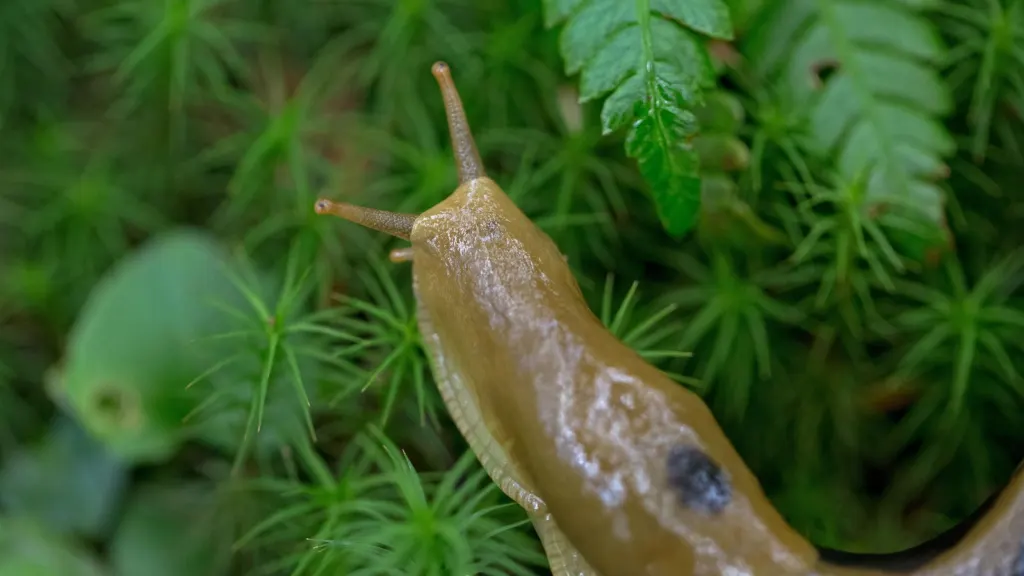
A banana slug in a Pacific Northwest forest. Photo: USFWS - Pacific Region / Wikimedia Commons, public domain
A slug-control product sold on farms in Europe, Canada and Kenya killed every Pacific banana slug it was tested on in an Oregon State University lab study, and the slugs in that study came from the Oregon coast.
The researchers say the results are a reason to slow down before the product, marketed as Nemaslug, is approved for use in the United States. It is not permitted here now, and the team writes that more work is needed on how it affects native species.
For the North Coast, the finding touches one of the most familiar animals on any wet forest trail. The Pacific banana slug ranges from Alaska to California, can grow to nearly 10 inches, and is the world’s second-largest land slug, behind only Europe’s ash-black slug, according to OSU’s Nov. 12 announcement.
What the lab found
Dee Denver and Emily Taylor of the OSU College of Science tested two products on 178 juvenile and adult banana slugs collected at the Oregon coast in spring 2024. The study, published in PLOS One, ran for 38 days.
- Original Nemaslug, built on a tiny parasitic worm called Pellioditis hermaphrodita, killed every banana slug exposed to it.
- Nemaslug 2.0, based on the related P. californica, was not uniformly lethal, but 80% of the juvenile slugs exposed to it died.
- In the unexposed control groups, 84% of juveniles and 96% of adults survived the experiment.
The nematodes work by entering small openings in a slug’s body, fatally infecting it, then reproducing inside the dead host and moving on to find another. That is useful against the gray field slug and other invasive pests. The question is what they do to everything else.
“This research has pretty big implications for biodiversity conservation,” Taylor, an OSU graduate student during the study who now works at Oregon Health & Science University, said in the university’s release. “The Northwest, due to its rainy climate, is a terrestrial gastropod hotspot.”
Why farmers want it, and why the researchers are wary
Invasive European slugs feed on crops, leaves and seeds, and a 2021 OSU analysis put their damage to Oregon’s grass seed industry at $60 million to $100 million over the decades, the Oregon Capital Chronicle reported. Some of the same OSU scientists once pointed to Nemaslug as a gentler alternative to chemical slug baits.
Both nematode species are already in the Northwest. A 2018 paper reported P. hermaphrodita in Oregon for the first time, and Denver and Rory McDonnell of the OSU College of Agricultural Sciences found P. californica in Oregon during a 2018-19 survey. How widespread either one is has not been determined, Denver said.
The study builds on earlier OSU work showing P. hermaphrodita is also deadly to the Pacific sideband snail, another native of Northwest forests. The researchers point to the history of slug and snail biocontrol, including a non-native snail released in Hawai’i and other Pacific islands that led to the extinction of hundreds of native snail species.
“Beyond factors like rising global temperatures and habitat loss,” Denver said in the release, “gastropods have historically suffered greatly from poorly designed and executed biocontrol attempts.” Land slugs and snails make up more than a third of documented animal extinctions since 1500, he said.
The work was funded by the U.S. Department of Agriculture. Other OSU collaborators were Dana Howe of the College of Forestry, Indira Kulkarni Ebner of the College of Science and Casey Richart of the College of Agricultural Sciences.
Banana slugs do much of their work out of sight, breaking down organic matter and spreading seeds on the forest floor in places like the Clatsop and Tillamook state forests and the headland trails at Cape Lookout. More environment coverage is in our Energy & Environment section.
Neither Nemaslug product can be sold in the U.S. without federal and Oregon approval, and the OSU team says more research is needed on non-target species and on how far the nematodes have already spread before regulators decide.
Add North Coast Oregon as a preferred source on Google (opens in a new tab)

 By

 By
