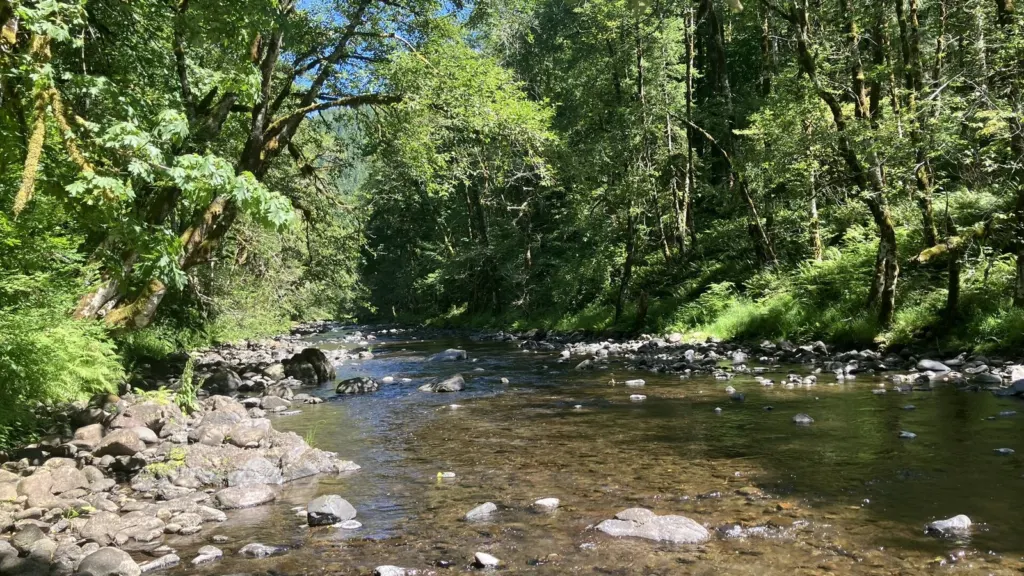
Federal Permit Sets 70-Year Rules for Tillamook and Clatsop State Forests
Photo: Jsayre64, CC BY-SA 4.0, via Wikimedia Commons.
A federal permit issued this fall sets the rules for how the Clatsop and Tillamook state forests will be logged, protected and managed for most of the rest of the century, with salmon and steelhead in North Coast rivers at the center of the plan.
NOAA Fisheries issued an incidental take permit on Sept. 11, 2026, for the Oregon Department of Forestry’s Western Oregon State Forests Habitat Conservation Plan. The permit runs for 70 years. It allows ODF to carry out timber harvest, road building and other forest management on covered lands, even if those activities incidentally harm federally protected fish, as long as the department follows the conservation measures laid out in the plan.
What the plan covers
The habitat conservation plan applies to about 640,000 acres of state forest land in western Oregon. Roughly 65% of that land is in Tillamook and Clatsop counties, which means the plan will shape management on the forests that line the Wilson, Trask, Kilchis, Miami, Nehalem and Salmonberry rivers and the hills above Astoria, Seaside and Tillamook.
The NOAA permit covers 10 fish species and populations listed under the Endangered Species Act or considered in the plan, including three populations of coho salmon, four of Chinook salmon, Columbia River chum, Upper Willamette winter steelhead and eulachon, the small smelt once so abundant in the Columbia that it was known as candlefish.
Under the plan, ODF sets aside conservation areas where harvest is restricted and wider buffers along streams to keep water cool and shaded, limit sediment and allow large trees to eventually fall into channels and create habitat for young fish. Outside those areas, timber harvest continues.
Why this matters on the North Coast
The state forests are a major source of timber revenue for local governments. About two-thirds of the money from state forest timber sales goes to the counties and local taxing districts where the land sits, including schools, fire districts and other services. Tillamook and Clatsop counties have long depended on that revenue, and harvest levels under the new plan are expected to be lower than under past approaches as more land is set aside for habitat.
That tradeoff has been debated for years. Counties, timber companies and mill workers have warned that reduced harvests will cut jobs and local budgets. Conservation and fishing groups have argued that more protection for streams and older forest is needed to recover salmon runs that support commercial and sport fishing along the coast.
The Wild Salmon Center, a Portland-based conservation group, highlighted the plan in an Oct. 13 post, pointing to the importance of the Trask, Wilson, Kilchis, Miami, Nehalem and Salmonberry rivers for wild salmon and steelhead. The group also noted that outdoor recreation in the region is a significant economic driver, citing a figure of about $550 million for the area’s outdoor recreation economy.
State Forester Kacey KC, NOAA Fisheries’ Lance Kruzic and ODF’s Mike Wilson were among the officials quoted in announcements of the permit. The plan was developed over several years with federal agencies, counties and other stakeholders.
A second permit still to come
The NOAA permit is only half of the federal approvals the plan needs. The U.S. Fish and Wildlife Service is responsible for land-based and freshwater species covered by the plan, including the northern spotted owl and the marbled murrelet, a seabird that nests in old coastal forests. ODF expects that permit later in 2026 or in early 2027.
Once both permits are in place, ODF will manage the forests under the plan for decades, with monitoring and reporting required to show whether the conservation measures are working. The plan includes provisions for adjusting management if results fall short.
What anglers and forest users can expect
For the people who fish the North Coast rivers, hike and camp in the Tillamook State Forest or drive Highway 6 along the Wilson River, the change will be gradual. Logging will continue in parts of the forest, but over time more streamside areas and older stands are expected to be left standing.
The bigger question is whether the plan delivers what both sides want from it: steadier, legally secure timber sales for counties, and healthier runs of coho, Chinook and steelhead in rivers that have struggled for decades. The answers will come slowly, measured in fish counts and harvest reports over the life of a permit that runs until 2096.
More in Energy & Environment
North Coast Land Conservancy at 40: The Seaside Land Trust Behind 36 Habitat Reserves
 By Megan Harlow ·

NRC Renewed Wolf Creek Nuclear Plant’s License for 20 More Years: What the Decision Covered
 By Corey Lindqvist ·

The Warrenton LNG Fight: How a Decade-Long Energy Proposal Ended on the Columbia
 By Dana Whitcomb ·