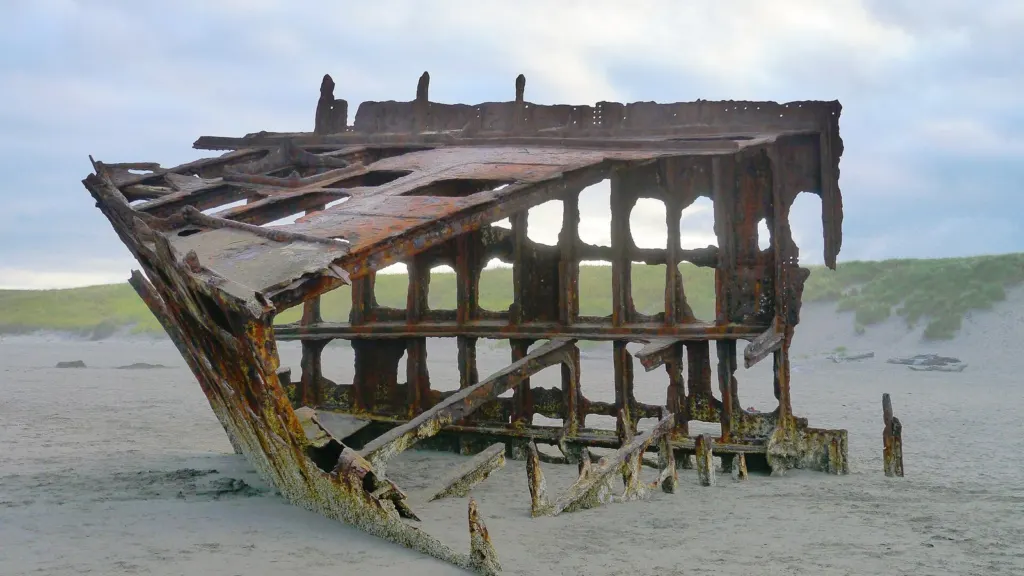
Captain H. Lawrence and the wreck of the Peter Iredale
Photo: Rick Obst, CC BY 4.0, via Wikimedia Commons.
The Peter Iredale was a four-masted steel bark built in 1890 in Maryport, England. In October 1906 it was bound for Portland under Captain H. Lawrence, sailing in ballast to load wheat for the United Kingdom.
Approaching the mouth of the Columbia in heavy weather, the ship was driven ashore on Clatsop Spit. The crew, which included two stowaways, abandoned ship and were rescued by a lifesaving crew from Point Adams. Nobody died.
The inquiry
A court of inquiry later cleared Captain Lawrence and his officers of negligence, finding that wind and currents were responsible. Wrecks were common on this stretch of coast; the area around the river’s mouth is known as the Graveyard of the Pacific, with thousands of vessels lost since the early 1800s.
Why the wreck remains
The ship was too badly damaged to be refloated, and the owners sold it for salvage. Over time, most of the hull broke up and was buried in sand, but parts of the bow and masts are still visible at Fort Stevens State Park, near Hammond.
It is one of the most accessible shipwrecks on the West Coast, and at low tide visitors can walk right up to the rusting frame. The wreck is a popular stop, especially at sunset, and appears in countless photographs.
Fort Stevens itself, a former military post, has its own history. In June 1942, a Japanese submarine fired shells toward the fort, one of the few attacks on the continental United States during World War II. The shells did little damage.
 By
 By