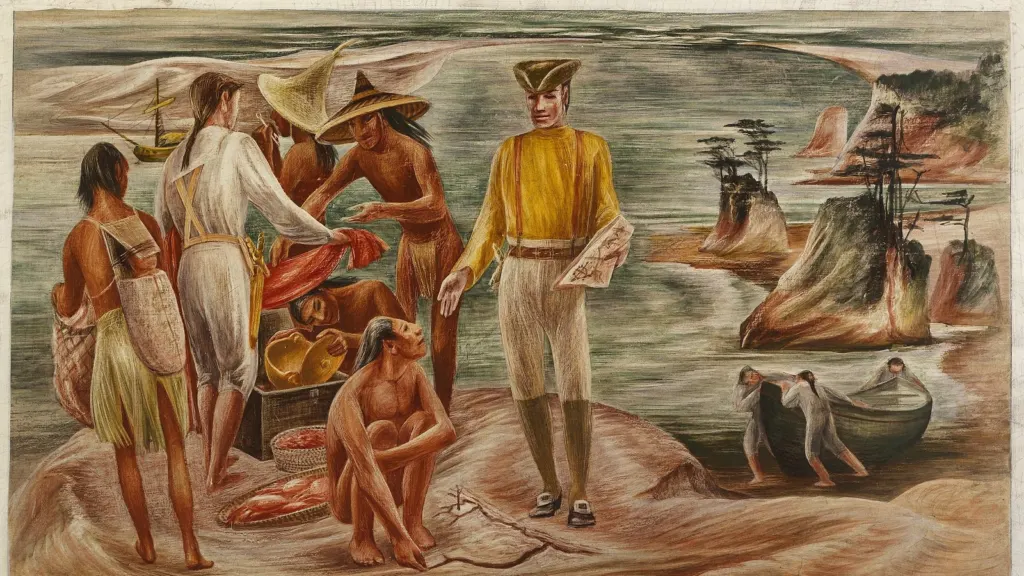
Robert Gray named the Columbia for his ship. His first Oregon stop was Tillamook Bay
Lucia Wiley's study for the mural Capt. Gray Entering Tillamook Bay, made for the Tillamook post office and now at the Smithsonian American Art Museum. Photo: Lucia Wiley / Wikimedia Commons, public domain
Robert Gray is the reason the river at Astoria’s door is called the Columbia. The Rhode Island fur trader sailed his ship, the Columbia Rediviva, across the bar on May 11, 1792, the first documented ship to anchor in the estuary, and named the river for the vessel. Four years earlier, his first stop on the Oregon coast was Tillamook Bay, and it ended with a crewman dead on the beach.
Both moments sit at the start of the North Coast’s written history, and both are more complicated than the names on the map suggest.
A trader, not an explorer
Gray was born May 10, 1755, in Tiverton, Rhode Island, and went to sea young, according to the Oregon Encyclopedia, a project of the Oregon Historical Society. His family said he served in the Continental Navy, though that is undocumented. In 1787, Boston investors chose him to captain the sloop Lady Washington on a voyage to buy sea otter furs on the Northwest Coast. He came home in command of its companion ship, the Columbia, by way of China, the first American to sail around the world.
The encyclopedia describes him as a “no-nonsense trader” who drove hard bargains with Native sellers. He also sailed too close to dangerous coastlines, a habit that damaged the ships he commanded, and he wore a patch over one eye for most of his career.
Murderers Harbor
In August 1788, the Lady Washington worked down the Oregon coast looking for furs. The ship’s 19-year-old third officer, Robert Haswell, kept a journal that the Oregon History Project has published with notes. On Aug. 14, a party entered what was probably Tillamook Bay. The Tillamook people were friendly at first, according to Haswell’s account, offering berries, crabs, salmon and otter skins to sailors weak from scurvy.
Two days later, a young crewman from the Cape Verde Islands, Marcus Lopez, found that a Tillamook man had taken his cutlass and chased him. Lopez was surrounded and killed. The rest of the shore party ran for the longboat. The traders named the place Murderers Harbor. Lopez was probably the first person of African descent to set foot in what became Oregon, the Oregon History Project notes.
The Oregon Encyclopedia’s Tillamook Bay entry calls Gray’s crew the earliest recorded U.S. citizens to visit the bay, which people had already lived around for at least 11,500 years.
Crossing the bar
Gray had noticed a strong current off the mouth of the Columbia on that first trip. Spanish navigator Bruno de Heceta had seen the river’s mouth in 1775 but did not try to enter it, and British trader John Meares concluded in 1788 that there was no river at all, naming the headland Cape Disappointment, as HistoryLink recounts. In late April 1792, British Capt. George Vancouver passed the mouth and also kept going.
Gray did not. On May 11, he found a channel across the bar and took the Columbia into the river, which the Chinookan peoples living on both banks called Wimahl, or Big River. His crew traded upriver for about nine days.
Both voyages also show Gray’s harder side. The Oregon Encyclopedia counts two occasions, one at Tillamook Bay and one at what is now Grays Harbor, when Gray fired on Native traders who would not accept his price for furs, killing several. The second came on May 9, 1792, two days before he entered the Columbia. Fifth mate John Boit wrote in his log: “I am sorry we was oblidg’d to kill the poor Divells, but it cou’d not with safety be avoided,” the Oregon Encyclopedia notes.
What his name is on now
Gray’s entry gave the United States an arguable claim of discovery during the long talks with Britain that ended in the Oregon Treaty of 1846, though the encyclopedia says it played no material role in the final deal. He handed his sketch chart to Vancouver, who then sent Lt. William Broughton up the river that October to map it for Britain.
Gray returned to Boston, married Martha Howland Atkins in 1794 and commanded a privateer during the Quasi-War with France. He likely died of yellow fever in South Carolina in 1806. No documented portrait of him exists. His name survives in Grays Harbor, Grays River and Grays Bay in Washington, and in a Portland middle school.
He shares that early chapter with the people we have profiled recently, including Gabriel Franchère, the Fort Astoria clerk who wrote Astoria’s first history, and with the stories behind Terrible Tilly and the Van Dusens of Astoria. More are collected on our Notable People page. For the river’s later maritime history, the Columbia River Maritime Museum in Astoria recently opened its new Mariners Hall.
Add North Coast Oregon as a preferred source on Google (opens in a new tab)
More in Notable People

tonies® Partners with Ronald McDonald House New York to Bring the Magic of Screen-Free Storytelling and Imaginative Play to Children and Families
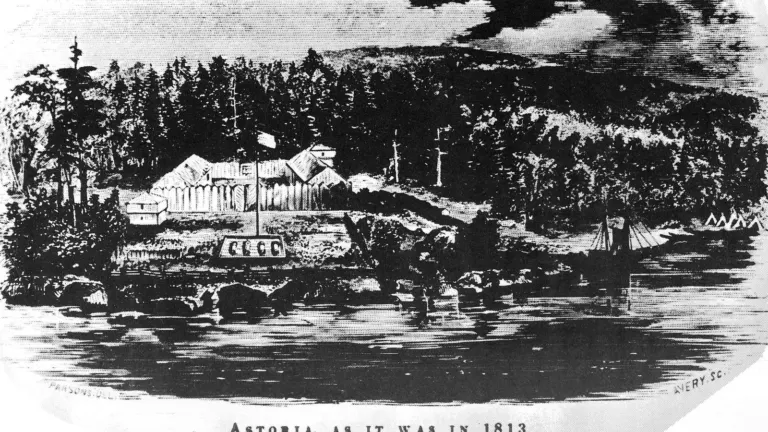
Gabriel Franchère, the Fort Astoria clerk whose diary became Astoria’s first history
 By Megan Harlow ·