Lawsuit seeks a decision on relisting the gray whales that migrate past the North Coast
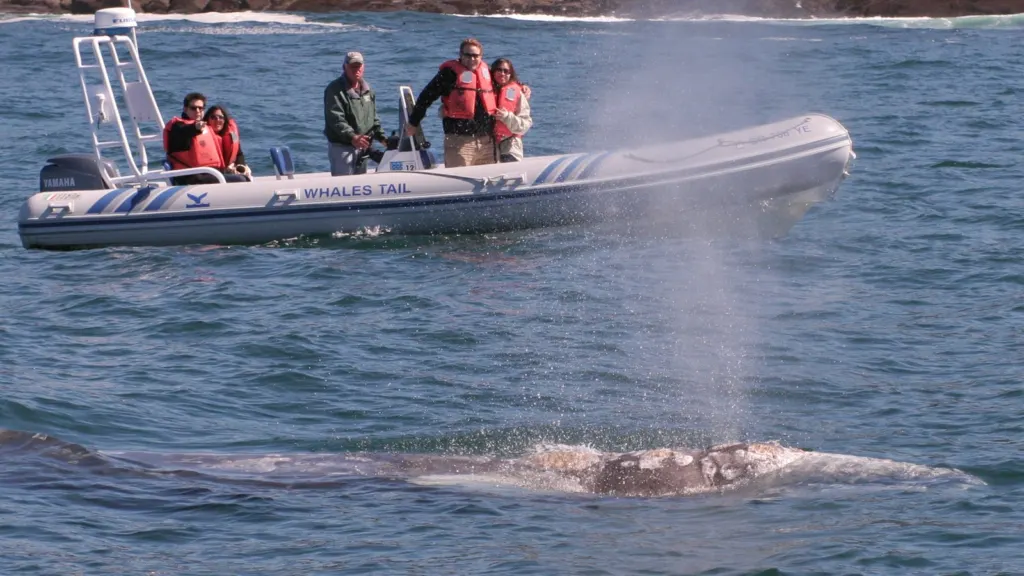
A gray whale surfaces off Depoe Bay, September 2012. Photo: Oregon Department of Fish & Wildlife / Wikimedia Commons, CC BY-SA 2.0
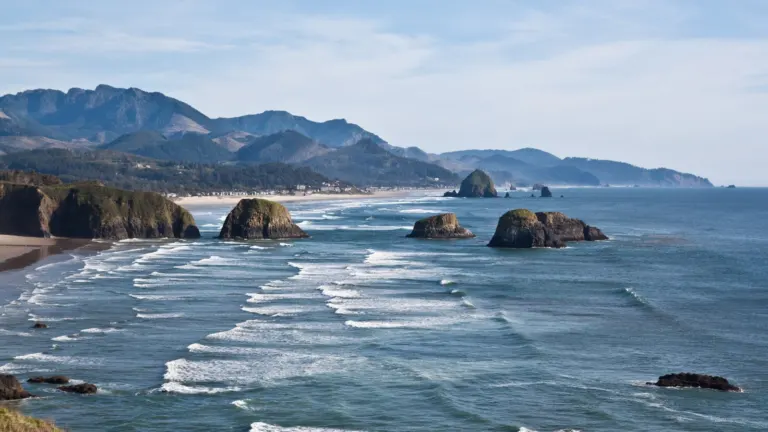
The gray whales that pass Cannon Beach, Cape Meares and Cape Lookout every winter have become the subject of a federal lawsuit. Three conservation groups filed suit on Nov. 17 to force the National Marine Fisheries Service to decide whether the Eastern North Pacific population should go back on the endangered species list. The agency took it off in 1994.
The complaint (Case No. 3:26-cv-13925 in the U.S. District Court for the Northern District of California) was filed by Oasis Earth, the Center for Biological Diversity and the International Marine Mammal Project of Earth Island Institute. It does not ask the court to list the whales. It asks the court to make the agency answer a petition it has had for 15 months.
A petition with no answer
The Endangered Species Act gives the fisheries service 90 days to say whether a listing petition presents enough information to merit a full review. If the answer is yes, a final decision is due within a year of the petition’s filing. According to the complaint, the agency received the gray whale petition on Aug. 24, 2025. That put the 90-day finding due on Nov. 22, 2025, and the 12-month finding due by Aug. 24, 2026. Neither has been published.
The petition’s author, Oasis Earth founder Richard Steiner, has ties to this coast. The complaint says he did graduate marine research off Oregon for Oregon State University in the 1970s and later fished Dungeness crab, halibut and albacore off the state. It says he wrote to the agency for updates in February and April. In February the agency told him it was working on the finding and hoped to dedicate more time to the petition “in the upcoming month(s).”
The case the groups make
The complaint says the service has recorded 192 gray whale deaths along the West Coast between Alaska and Mexico so far in 2026, including 31 in Washington, 27 in Alaska and 13 in the San Francisco Bay Area. It notes that most dead whales sink and are never counted. It also says only 85 calves were reported in 2025, the lowest number since record-keeping began, and that most whales that stranded this year were malnourished.
The groups blame mainly a collapse of the seafloor food web in the Arctic feeding grounds, as sea ice declines. They also point to ship strikes, which killed at least 14 gray whales in 2026 according to the complaint, and to entanglement in fishing gear. The service confirmed 131 gray whale entanglements off the U.S. West Coast between 2005 and 2024. The complaint says many of those involved commercial Dungeness crab gear, which matters in Astoria and Warrenton, where crab is the most valuable catch and this winter’s season, held up in part by weather-delayed meat testing, is already delayed to at least Dec. 16.
This die-off follows the federal unusual mortality event declared from 2019 to 2023. The complaint counts 216 gray whale deaths in 2019 alone.
What the agency’s own count shows
The complaint relies on a population that has fallen by about half in a decade: from an estimated 26,960 whales in 2015/2016 to between 11,700 and 14,200 in 2024/2025.
The fisheries service’s newest survey complicates that picture. In a technical memorandum published in July, scientists at the Southwest Fisheries Science Center estimated 17,750 gray whales during the 2025/2026 southbound migration, up from 12,950 a year earlier. Observers at Granite Canyon on the central California coast counted 2,563 whales over 39 survey days between Jan. 5 and Feb. 13. The best day was Jan. 19, with 158 whales.
The agency’s scientists called the higher number “an encouraging finding,” but they did not treat it as a recovery. Recent jumps in the estimate exceed the fastest rate at which gray whales can grow, and they came during years when calf production stayed low. The authors wrote that factors other than births and deaths “must be affecting” the count. They listed sampling error, analytical bias, changes in how easily whales are spotted, and possible changes in migration behavior. The 2025/2026 estimate does not appear in the complaint.
That leaves the core question to the agency once it responds: whether a population with record-low births and repeated strandings, but an uncertain headcount, meets the legal test for a threatened or endangered listing. A 90-day finding only decides whether a full status review is warranted.
Watching from the North Coast
None of this changes the migration calendar. According to the Oregon Whale Watch program run by Oregon Parks and Recreation, the southbound migration peaks over the winter holidays. At its height, about 30 whales an hour pass the Oregon coast. Volunteers staff viewpoints from 10 a.m. to 1 p.m. during the program’s Whale Watch Weeks, and they file a daily tally of whales and visitors afterward. The program has run since 1978, when researchers began counting migrating gray whales off Yaquina Head.
Those shore counts are not the federal survey, but they are one of the few ways coast residents can see the trend for themselves. On the North Coast, the headlands at Ecola State Park, Neahkahnie Mountain, Cape Meares and Cape Lookout look out over the migration route. If you find a stranded or dead whale on the beach, keep your distance and report it to the West Coast marine mammal stranding network through NOAA Fisheries rather than touching it.
For more environment coverage from Clatsop and Tillamook counties, see our Energy & Environment section.
Add North Coast Oregon as a preferred source on Google (opens in a new tab)