Astoria would cut park ejections from a year to 90 days and add an appeal process
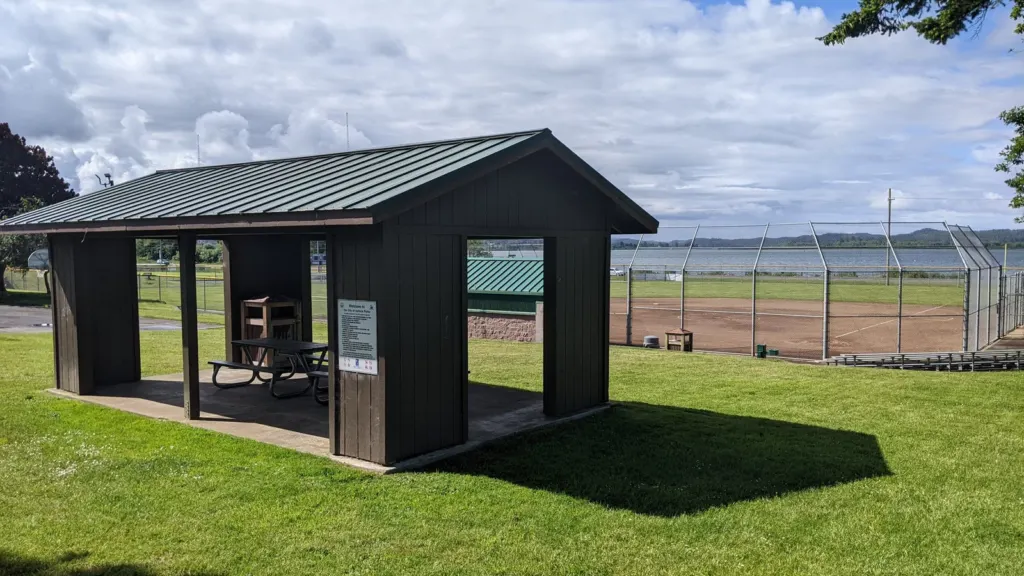
The picnic pavilion and ball field at Tapiola Park in Astoria. Photo: Bobjgalindo / Wikimedia Commons, CC BY-SA 4.0
Astoria is rewriting the rules for kicking people out of its parks. Under an ordinance now before the City Council, a park ejection would last 90 days instead of a year. The city would lose its written power to seize and destroy property, and anyone ejected would get a formal way to challenge it.
The proposal, Ordinance 26-12, was set for a public hearing and first reading at the council’s Nov. 16 meeting, according to the meeting agenda packet. It amends Chapter 5 of the city code, which covers parks rules and regulations. A city ordinance needs a second reading before adoption, and the draft says this one would take effect 30 days after that.
How often Astoria ejects people from parks
The staff memo, signed by City Manager Scott Spence and prepared by Ryan Quigley, assistant to the city manager, includes the city’s own count. Astoria recorded 33 park ejections in 2024 and 42 in 2025. It recorded 25 more in 2026 through Aug. 10. Over the last three years, the memo says, only two people appealed.
Right now, the city’s practice is to bar a person from a park for a year. Staff recommended cutting that to 90 days and wrote the new limit directly into the code.
The changes came out of an Oct. 26 council work session. At that session, councilors went through ten proposed amendments aimed at cleaning up the municipal code, removing outdated language and bringing sections in line with current state law. The council told staff to bring the parks changes back as an ordinance. The City Attorney has reviewed the draft, the memo says.
What the new enforcement section says
The rewritten Section 5.933 still lets the parks director, the director’s representatives and police officers eject anyone who breaks park rules, city ordinances or state law. But it adds several limits:
- An ejection would apply only to the park where the violation happened.
- No one could be ejected solely for protected speech, peaceful assembly or other activity protected by the U.S. or Oregon constitutions.
- Every ejection would have to be in writing. The notice would list the date, the park, the facts, the rule broken, the duration, the appeal steps and the consequences of coming back.
Once an exclusion is final, a person who knowingly returns to that park could be prosecuted under Oregon’s criminal trespass laws, the draft says.
The ordinance also strikes the current subsection that gives the director and police authority to “seize, confiscate and destroy any property, thing or device in the park” that violates park rules. The memo lists that removal as one of the main goals, along with a clearer appeal process.
A new appeal process
A new Section 5.934 would set out how to fight an ejection. A person would have 10 calendar days to file a written appeal with the parks director. The review would be handled by the director or by an impartial hearing officer who was not involved in the exclusion. The hearing would have to happen within 10 business days unless the person asked for more time. The person could appear, submit documents, call witnesses and bring a lawyer.
A timely appeal would put the ejection on hold until a decision is made. The exception is an ejection based on violence, credible threats of violence or substantial property damage. In public safety cases, the hearing officer could keep the ejection in place during the appeal with written findings.
The reviewer could uphold, modify, shorten or rescind the exclusion. After that, the person could take the hearing officer’s decision to the Astoria Municipal Court judge by notifying the court within 10 days. The judge’s decision would be final.
A broader definition of “park”
The ordinance also updates the definitions of “director” and “park.” The new park definition covers any property the city owns, leases, operates or controls and holds open for public recreation, scenic enjoyment, cultural use or conservation. It names playgrounds, athletic fields, trails, greenways, natural areas, overlooks and viewing platforms, plus their parking areas and buildings. It also includes any property listed as a park in the Astoria Parks Master Plan.
The same Nov. 16 agenda carried several other items, including the proposal to make the city’s utility bill assistance program permanent and the closeout of the wastewater plant’s headworks project. The parks changes come in the same month as Astoria’s unusually close mayoral race. Cannon Beach is also working through new housing rules, including its offer to pay owners who rent to local workers.
More coverage of city councils and county boards across Clatsop and Tillamook counties is on our politics and government page.
Add North Coast Oregon as a preferred source on Google (opens in a new tab)

 By