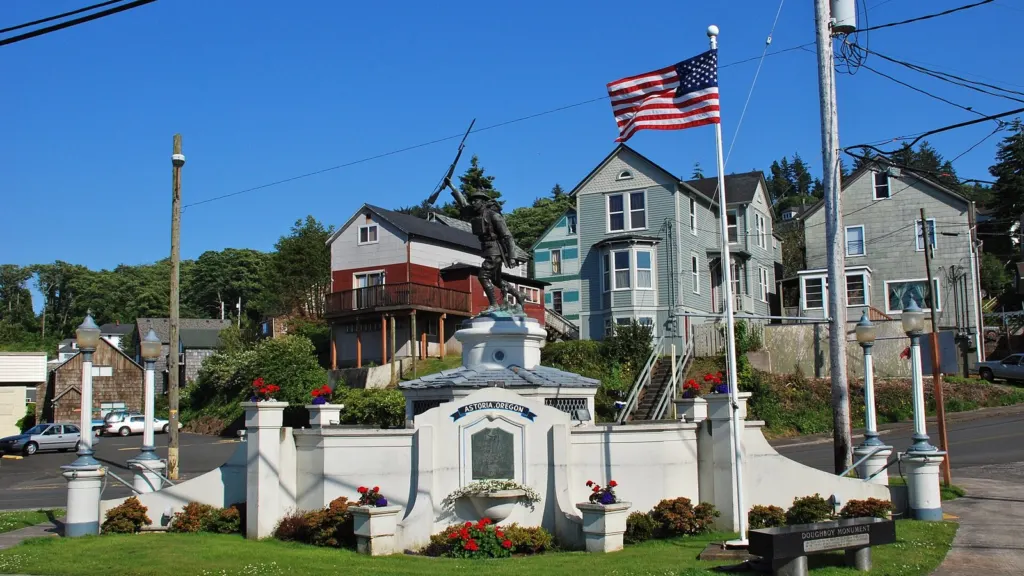
Astoria’s Doughboy, and the restroom under it, turn 100
At 11 a.m. on Wednesday, the bells rang in Astoria for a ceremony at the corner of West Marine Drive and Columbia Avenue, where a bronze soldier has been charging out of a trench for 100 years.
The Astoria Victory Monument, which most people in town just call the Doughboy, was first dedicated on July 21, 1926. On Veterans Day the city rededicated it, in a ceremony organized with the Clatsop County Historical Society, American Legion Post 12 and local preservation groups, according to The Astorian. A second rededication followed at 12:30 p.m. at the Astoria Public Library, for its Veterans Memorial Flag Room.
The figure on top is a casting of “Over the Top at Cantigny” by Chicago sculptor John Paulding. It depicts the American assault at Cantigny, France, on May 28, 1918, which city historian John Goodenberger describes as the first significant American victory of World War I. Paulding’s “Over the Top” designs were sold to towns across the country in the 1920s, as communities raced to put up memorials to the men they had sent to France.
What makes Astoria’s version unusual is underneath. Local architect Charles T. Diamond designed a Spanish Revival concrete base that doubles as a public restroom. When the monument was added to the National Register of Historic Places in 1984, it became, according to Goodenberger and city planning consultant Rosemary Johnson, the first public bathroom on the register.
Built by subscription in Uniontown
The money for the memorial did not come from the city treasury. The Clatsop Post of the American Legion led a local subscription drive in the mid-1920s, with help from Uniontown business associations. The spot was chosen on purpose. Uniontown was then the center of Astoria’s large Finnish community and the commercial crossroads of the west end of town.
The plaque on the base still reads: “Dedicated to soldiers of World War of Clatsop County by the City of Astoria July 21, 1926.”
Clatsop County lost 33 people in the war, according to the list published with this week’s ceremony. The first county death was Gerald A. Malarkey of Warrenton. The names include men from Jewell, Elsie, Westport, Knappton, Wauna, Hammond, Kerry, Svensen and Seaside, a reminder of how many small river and timber communities sent people overseas.
The 2017 crash
The monument has had its own rough patches. In 2017, while restoration work was already underway ahead of the 2018 centennial of the war’s end, a vehicle hit its eastern side, damaging the entry, planter boxes and lamp posts. Johnson, who led that restoration, said the crash showed the crew that the bronze statue needed to be better secured. It had been held in place, she said, by “really just sitting by its own weight and a couple screws.”
The repairs were paid for with grants from the state Historic Preservation Office and the Samuel S. Johnson Foundation, with in-kind work from Clatsop Community College’s historic preservation students.
The library’s Flag Room
The Flag Room rededication tied the Doughboy to a second, less visible memorial. When Astoria built its current library in 1967, local veterans gave roughly $60,000 toward construction on the condition that a room be dedicated to Clatsop County residents who served in wartime, Goodenberger said. The room has hosted veterans’ observances and community meetings ever since. Ahead of Wednesday’s event, library director Suzanne Myers Harold, Goodenberger, Johnson and Lower Columbia Preservation Society researcher Rachel Jensen spent part of the week rehanging historical paintings and plaques there.
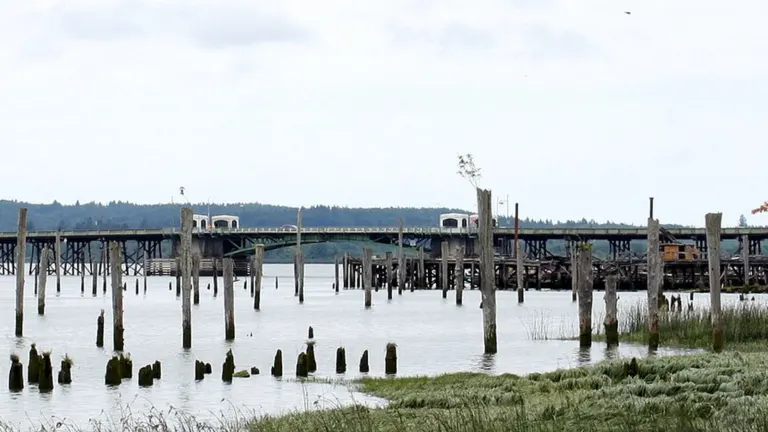
The Doughboy stands at the west end of the Astoria Riverwalk’s Uniontown stretch, a short walk from the Astoria-Megler Bridge.
The ceremony came a week after a busy election on the coast. Our coverage of the Astoria mayor’s race continues as final ballots are counted.
Add North Coast Oregon as a preferred source on Google (opens in a new tab)
 By