Oregon’s last revenue forecast before the 2027 session: little change, no kicker
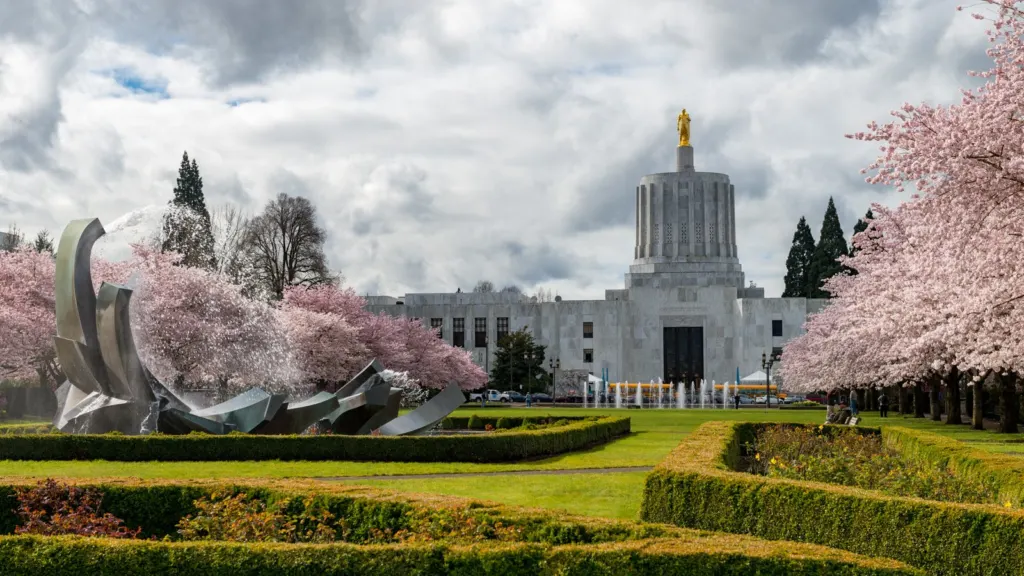
The Oregon State Capitol in Salem. Photo: Gary Halvorson, Oregon State Archives / Wikimedia Commons, CC BY 4.0
Oregon lawmakers will build the next two-year state budget on a revenue picture that barely moved this fall. The state’s economists told the Legislature’s revenue committees on Wednesday, Nov. 18, that their outlook is “little changed,” with no personal income tax kicker in sight and a recession risk they put near 18%.
The Oregon Economic and Revenue Forecast from the Office of Economic Analysis is the last one before the 2027 session opens in January, and the governor’s recommended budget, due in December, will be based on it.
“The overarching theme of this forecast is no news, no real change in terms of the economic outlook or the revenue picture,” Chief Economist Carl Riccadonna told reporters, according to the Oregon Capital Chronicle.
The numbers that matter in Salem
For the budget period that ends June 30, 2027, General Fund revenue is up only about $11 million from the previous forecast, the report says. Income tax collections came in a little stronger, mostly from capital gains, dividends and retirement account withdrawals, while estate taxes and interest earnings fell.
- Ending balance: The General Fund is now projected to finish the biennium with $411 million, which is still $62 million below what legislators expected when they adjourned in 2025.
- Next budget: Total resources for 2027-29 are about $245 million higher than previously projected, OPB and the Capital Chronicle reported.
- Lottery: Earnings are $12 million above the prior forecast, almost all of it from the latest quarterly transfer.
- Corporate activity tax: Up $15 million, largely because refunds in the fall filing season were lower than expected.
- Marijuana taxes: Down $1 million, a 0.4% change for the biennium.
No kicker for households, a small one for schools
Personal income and other non-corporate revenues are projected at $32.4 billion, which leaves them $524 million short of the threshold that would trigger the personal kicker rebate, the forecast says. That means households should not count on a personal kicker from this budget cycle unless collections jump in the spring filing season.
Corporate income taxes are just over their own kicker line. If the forecast holds, that would send about $71 million to education spending in 2027-29. The economists noted that federal tax changes in House Resolution 1, and related Oregon tax law changes, cut corporate collections by an estimated $191 million; without them, the corporate surplus would be much larger.
Senior Economist Michael Kennedy cautioned that “with a tax season left to go, there’s still potential” for the projected gain to evaporate, the Capital Chronicle reported.
Inflation and fuel are the risks
The report describes an economy in the middle of its cycle, with national growth of 3.4% in the third quarter, falling unemployment and stronger hiring in recent months. Oregon’s unemployment rate sat at 5.2% for seven months and has since eased to 5.0%. The downside is inflation, which the economists say has proved entrenched, driven by energy prices, tariffs, labor costs and wholesale price pressure. Forecasters broadly expect the Federal Reserve to raise interest rates further, the report says.
Gov. Tina Kotek said in a statement that the forecast shows the state “has steady financial footing on which to protect essential services.” Senate Republican Leader Bruce Starr of Dundee warned against “permanent spending decisions based on stock market gains that could disappear overnight,” the Capital Chronicle reported.
What it means on the coast
The forecast’s population section is a reminder of why coastal budgets feel tight. Oregon grew 1.4% between the 2020 census and 2025, but the coast and the south lost people or grew slowly, the report says. Tillamook County was one of 12 counties that lost population over that span, along with neighboring Lincoln. With births now below deaths statewide, the economists expect future growth to come entirely from people moving in.
Several state decisions with direct North Coast stakes will be made against this backdrop next year, including how to close the transportation funding gap ODOT has warned about and how state parks manage changes like the extended Cape Lookout closure. The North Coast’s new state senator from Senate District 16 will be part of that budget debate. More coverage is in our Politics & State Government section.
Add North Coast Oregon as a preferred source on Google (opens in a new tab)

 By