Astoria council weighs making its utility bill help permanent after a slow first year
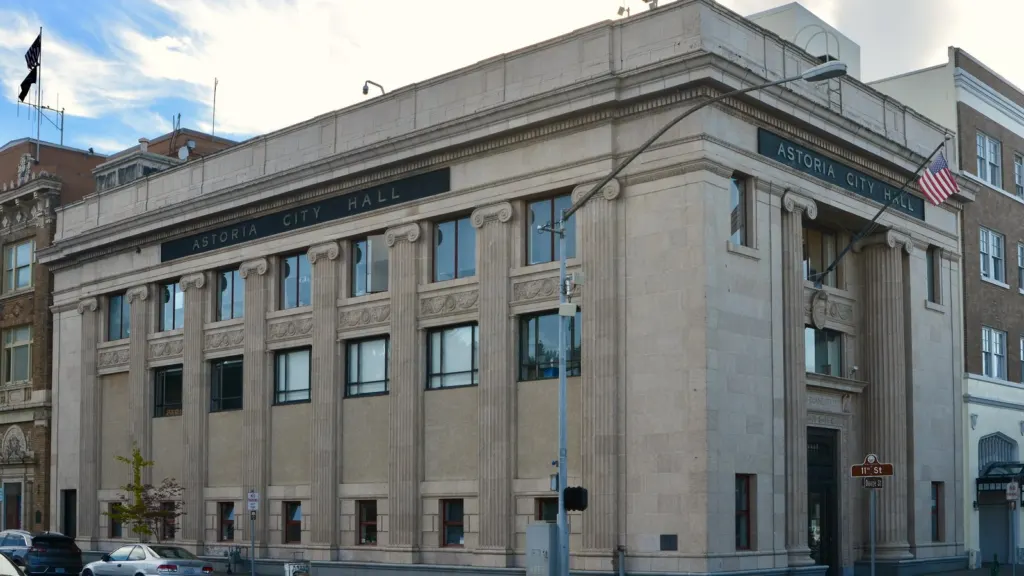
Astoria City Hall at 1095 Duane St., where the council meets Monday at 6 p.m. Photo: Steve Morgan / Wikimedia Commons, CC BY-SA 4.0
Astoria’s year-long test of helping low-income households with their water and sewer bills drew 48 applications and spent less than a fifth of its money. City staff still want to keep it, and the City Council will decide Monday night whether to make the program permanent.
The item is on the agenda for the council’s 6 p.m. meeting at City Hall, 1095 Duane St. The memo from City Manager Scott Spence and the full pilot report, prepared by Ryan Quigley, assistant to the city manager, are in the council agenda packet. Staff recommend a permanent Utility Assistance Program with $25,000 a year for bill credits, eligibility up to 60% of area median income, and a sliding scale that gives the most help to the lowest-income households. The report also calls for quarterly updates to the city’s finance team.
What the pilot found
The council approved the pilot in October 2025 after members asked during budget talks for a better way to help residents struggling with utility bills. Clatsop Community Action handles applications and verifies income, then sends the city a monthly list, and the city applies credits directly to bills. Both the agency and city finance staff reported no administrative problems.
Demand was the weak spot. In the first six months, when only households at or below 30% of area median income qualified, the program got 30 applications and approved 11. Of the 19 people turned down, 12 earned too much, and 11 of those fell between 31% and 50% of median income. Five more were in the wrong utility district. Those first approvals were mostly one-person households getting $17 per bill.
In April, the council widened the door to 60% of median income and switched to a three-tier scale. The second six months brought 18 applications and 16 approvals. Over the full year, 27 households were helped, and the report puts total credits at about $4,956 of the $25,000 set aside, roughly 19.8%. The overall budget was $27,500, with $2,500 paying Clatsop Community Action to run it.
How much help a household gets
Astoria bills every two months, and the pilot covered three of a household’s six bills a year. Under the sliding scale, the credit per bill depends on income and household size:
- Below 40% of median income: 30% of a typical bill, from $51 for one person to $131 for five or more.
- 41% to 50%: 20%, from $34 to $88.
- 51% to 60%: 10%, from $17 to $44.
For a one-person household, the 60% line works out to about $3,375 a month in income. For a family of four, it’s about $4,820.
What the bills look like
The report lays out this year’s rates. A water customer pays a $47.76 base charge every two months plus $5.12 per 1,000 gallons. Sewer adds a $55.91 base charge, plus $6.23 per 1,000 gallons after the first 4,000, and a sewer surcharge on top of that. Before using a drop of water, an Astoria household owes $157.90 per bimonthly bill.
Using the city’s own consumption assumptions, a typical one-person household pays about $178 every two months, two people about $248, three about $318, and four about $387. That’s roughly $1,070 to $2,320 a year for water and sewer alone, before garbage or electricity.
The city is also paying off sewer plant upgrades. A separate item Monday closes out the wastewater treatment plant’s headworks project, which finished at $8,762,890, more than $1 million under its $9.8 million budget. Federal ARPA money covered $4.86 million, but the city also took a $3.48 million state Infrastructure Finance Authority loan at 2.02% over 25 years.
Why staff want to keep going
With so little of the money spent, the council could cut the budget. Staff are instead recommending the same $25,000, betting that a permanent program with steadier outreach will reach more people. The city advertised the pilot on Facebook, on KMUN and in The Astorian, through fliers at City Hall, through a mailer in utility bills and in talks to groups like the Astoria Senior Center.
Property owners have other costs on the way, too, including this year’s Clatsop County tax statements. Earlier this month, voters also rejected the vacant homes tax the city had pitched as a way to pay for housing work.
If the council adopts the program, households that think they qualify can apply through Clatsop Community Action. More on household costs on the North Coast is in our Finance section.
Add North Coast Oregon as a preferred source on Google (opens in a new tab)
 By