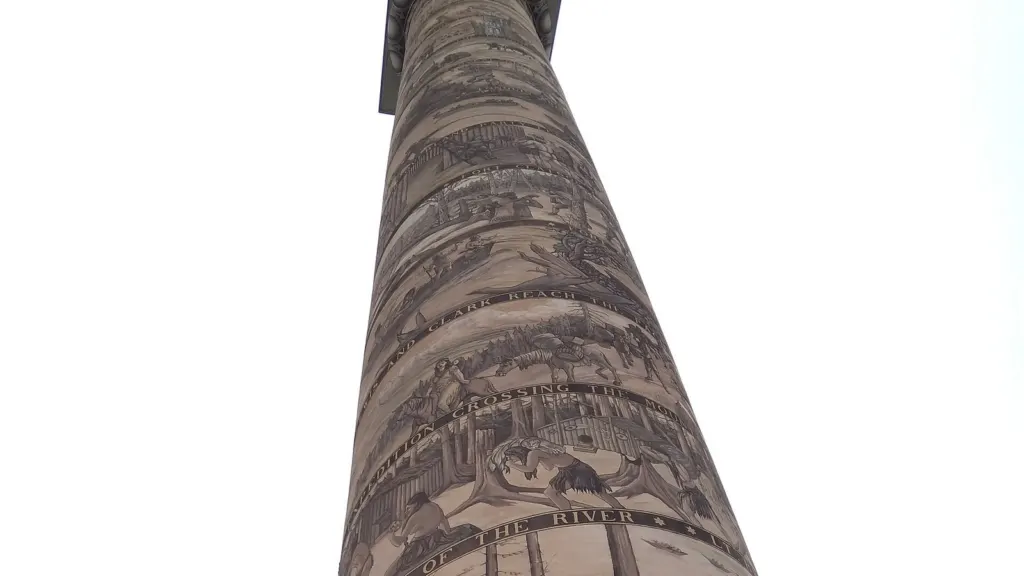
Attilio Pusterla and the frieze that wraps the Astoria Column
Photo: Bobjgalindo, CC BY-SA 4.0, via Wikimedia Commons.
The Astoria Column stands 125 feet tall on Coxcomb Hill, above the city. It was completed in 1926 with funding from the Great Northern Railway and Vincent Astor, a descendant of John Jacob Astor, and it was modeled on Trajan’s Column in Rome.
The pictures that spiral around its exterior are the work of Attilio Pusterla, an Italian-born artist who lived in New York. He used sgraffito, a technique in which layers of colored plaster are applied and then scratched away to create an image. It is rare on this scale in the United States.
The story on the column
The frieze shows a series of scenes from the region’s history, starting at the bottom with the wilderness before European arrival and moving upward through Captain Robert Gray’s crossing of the bar, the Lewis and Clark expedition, the founding of Fort Astoria and the arrival of the railroad. Read from the base to the top, it is a 1920s version of the region’s history, reflecting the views of its time, including the way Native people are depicted.
Restoration
Weather on the coast is hard on plaster. The column has been restored several times, most significantly in the 1990s and again in the 2010s, with conservators repairing and cleaning the frieze. The Friends of Astoria Column, a nonprofit, raised much of the money.
Visitors can climb the 164-step spiral staircase inside the column for views of the Columbia, the Astoria-Megler Bridge and Saddle Mountain. Many buy balsa wood gliders at the gift shop to launch from the top.

 By

 By
